Total War Saga Thrones Of Britannia Download
Total War University
THRONES OF BRITANNIA – Steel & Statecraft Update
Today we've released a new update for A Total State of war Saga: Thrones of Britannia. The Steel and Statecraft update builds on some existing mechanics and also address some player feedback from the last update.
Among other things, the update implements a new Political Difficulty option. We understand that some players like to claiming themselves with political manoeuvring, while others prefer to stay abroad from such back-stabbing. You can now tweak this surface area of the game separately from Campaign Difficulty. The politics system is as well undergoing some other changes, particularly in the events that come up most as the event of political actions.
Here are some more highlights of the changes that take been made.
Estates Overhaul
The purpose of Estates was to add challenges in managing a kingdom where each noble is playing the game of intrigue, looking to grab more power and land for themselves. However, the organization didn't have as much affect as we'd take liked, which is why Estates take received a rework to meliorate represent a male monarch granting land to his more important lords, thus ensuring their devotion to the crown. With the power of land ownership comes a responsibility for the owner to properly tend to his holdings – each Estate volition offer a positive outcome if given to the proper lord, or a negative one if the noble is not suited to presiding over such lands.
The nobles in turn do not sit down idly, hoping for deeds to fall in their lap. The Estate Want traits, which characters previously gained, take been replaced with requests, directed towards the crown in the form of missions. Every so often a lord in your faction will enquire to exist granted Estates, offer a reward in return. Only if you deem the noble ineligible or sense malicious intent, and you ignore their request, their loyalty will showtime to waiver.
We've added more weight to managing your Estates, and to help with that we've reorganized the Estates interface. Each lord will list the furnishings that they provide from Estates they own. Moving Estates effectually has been made easier – clicking on an Manor will grant information technology to the selected graphic symbol on the left. Beware, however, of dealing with Estates that are non in the king's possession – nobles are quite attached to their lands and volition rarely part with them without repercussions.
Traits
Traits depict the story of each character; their upbringing, their personality and the events that have occurred in their lifetime. Sifting through each character's history tin be cumbersome, which is why nosotros've stacked traits into groups. Each trait group is now represented by a imprint, with all furnishings of the traits within listed underneath. Clicking on a banner volition list all traits within that grouping, giving a detailed business relationship of the noble'southward qualities.
As mentioned previously, each trait group will list how it affects a character'southward Estates. The group with the nearly traits volition be marked with a large yellow icon, showing the lord's dominant characteristics and what effects they grant to the noble's state ownership.
Recruitment Revamp
Recruitment in Thrones of Britannia is take a chance based, similar to the fashion in which mercenaries worked in previous titles. While information technology's an interesting challenge to build armies with imperfect composition and size, information technology has downsides too, such equally elite units appearing scarcely, and losing your painstakingly assembled army tin can be a devastating blow to your campaign.
We've replaced this chance-based arrangement with cooldowns. When a unit of measurement blazon is recruited, in that location's now a fix number of turns earlier another becomes available. This retains the sense of pick limitation, merely rewards planning and removes the random punishment of non having enough units just because they didn't appear in the recruitment pool.
The time it takes to build a full army can exist lengthy, so recruitment events take been added, granting a quick supply of units to assist with defending territories, or adding a helpful button to your conquering.
Buildings, technologies and faction mechanics have all received new effects to meliorate the recruitment times of units. Nosotros've also eased the unlock requirements of military technologies, to make meaningful choices in ground forces management more than attainable.
Volume of Traits (Trait Browser)
With the added importance of graphic symbol traits, nosotros believe at that place is more purpose to managing your characters, seeking their all-time evolution. All traits present in the game are at present listed in the Book of Traits along with the condition of their acquisition.
The details of a trait will be locked until the player acquires that trait for the first time. (Nosotros still want players to experiment and find traits on their own, but unlocked trait information will now be readily bachelor).
The Book of Traits is persistent between campaigns, allowing players to chase for a specific trait in a afterward playthrough.
Buildings & Settlement Maps
Villages are getting a second, alternative building path directly from level 2. This should give players the opportunity to fine-tune their economy through minor settlements. The existing paths are vastly unchanged (rubber for some pocket-sized balance tweaks) for an easier transition.
We've besides created some new buildings that will feature on all settlement maps (both major ones and villages).
• Viking Gatehouse
• Viking Long Hall
• Viking Turf-roof Hall
• Viking Drinking Hall
• Viking House i
• Viking House 2
• Viking Firm iii
• Viking Business firm 4
• Anglo-Saxon Chieftains Firm
• Anglo-Saxon Slap-up Hall (under construction)
New Major Settlement Maps
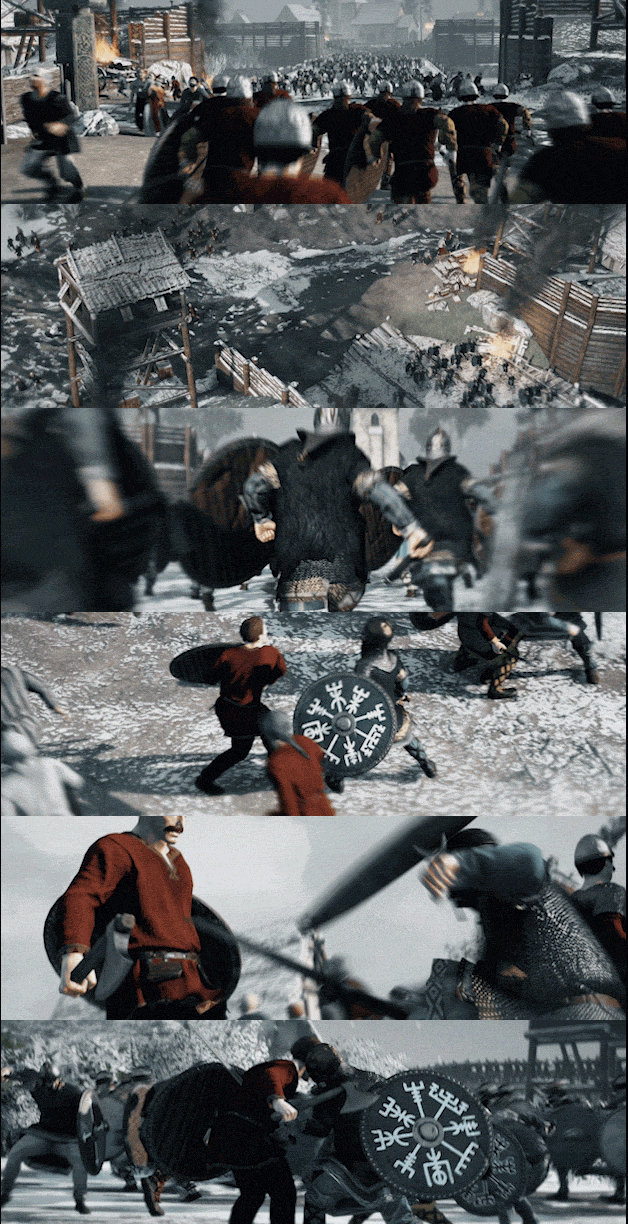
Since siege battles in Thrones of Britannia have been pop, we're making two brand new settlement maps, one based on Bebbanburg Castle, and the other on The Stone of Cashel.
• Map one - based on Bebbanburg Castle (used in-game for Bebbanburg and Eidenburg)
• Map ii - based on Stone of Cashel (used in-game for Caisil and Grianán Aileach)
Modern Support
Last merely by no ways least, we've made a couple of changes to help out Modders. Most notably, the Recruitment window can now accommodate whatever number of custom units (with a scroll-bar). Also retail pack files at present contain exported binaries for all bones UI components, in addition to the already existing composite templates.
And That'southward Not All…
The update features improvements to lots of other areas of the game, including updates to battle AI, performance optimisations, visual improvements, UI enhancements and more.
About This Game
A Total State of war™ Saga: Thrones of Britannia
The year is 878 AD, the embattled English language king Alfred the Great has mounted a heroic defence at the battle of Edington, and blunted the Viking invasion. Chastened – but not yet broken – the Norse warlords take settled across United kingdom. For the showtime time in nearly eighty years, the state is in a frail state of peace.
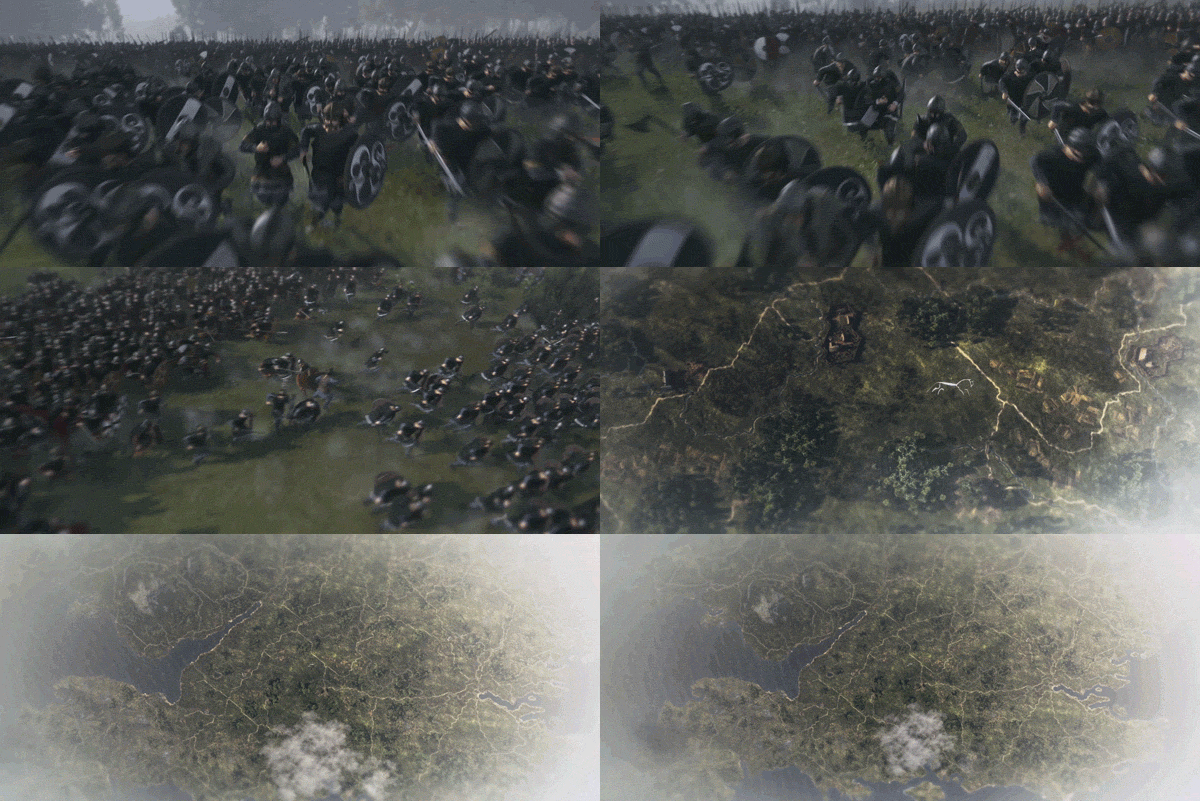
Throughout this sceptred isle, the kings of England, Scotland, Ireland and Wales sense a time of change approaching; a fourth dimension of opportunity. There will be treaties. There will be war. In that location will be turns of fortune that become the stuff of legend, in a saga that charts the ascent of one of history'due south greatest nations.
Kings will rise. One will dominion.
Thrones of Britannia is a standalone Full War game which volition challenge yous to re-write a critical moment in history, one that volition come to define the hereafter of modernistic U.k.. With x playable factions, y'all must build and defend a kingdom to the glory of Anglo-Saxons, Gaelic clans, Welsh tribes or Viking settlers. Forge alliances, manage burgeoning settlements, heighten armies and embark on campaigns of conquest across the most detailed Total War map to date.
Cull your strategy
The K Campaign offers multiple routes to a glorious Victory; aggressively expand your territory through forcefulness of arms, acquire renown through construction, avant-garde technology and influence, or complete a series of unique objectives based on your called faction's history. Once completed, steady yourself for a pregnant late-game challenge and the final, Ultimate victory condition.
Explore and conquer the British Isles
From the snowy highlands of Scotland to the orchards and meadows of Kent, push dorsum the fog-of-war and unveil the extent of Anglo-Saxon Britain. Varied towns, cities and rural settings inspire a host of dissimilar battleground environments. Experiment with the strategic opportunities afforded by newly capturable minor settlements. Throttle your enemies' trade routes and coax them out of strong, defensible positions.
Viking warlord or Anglo-Saxon king, define their legend
Each faction will confront a series of unique events and branching dilemmas, ofttimes based on authentic historical events and issues of the fourth dimension. Embark on Viking expeditions, manage the Anglo-Saxon peasant economy, each faction feels and plays differently. Carve out unique roles for your King and Nobles, customise their touch past making meaningful choices near their development and determine how their story will unfold.
'Classic' Total War gameplay refined
Includes many updates to core Total State of war mechanics - such as provinces, politics, technologies, recruitment, dilemmas and much more - designed to make your experience more immersive and more than meaningful.
Playable factions, cultures and kings:
Thrones of Britannia will include x playable factions, from 5 cultures, with a summary below.
The Anglo Saxons – West Seaxe and Mierce
When Roman rule in England ended, new kingdoms of Germanic stock coalesced in the counties now known as Northumbria, Mercia, Wessex, Essex, Sussex, E Anglia and Kent. The peoples of these regions came collectively to exist known as the Anglo Saxons.

West Seaxe
Faction Leader: Rex Alfred
Every bit the dominant Anglo-Saxon kingdom of southern England, the forces of Due west Seaxe – or Wessex in modern English – provided the isle's master resistance against the incursions of the Great Pagan Army. From the majuscule city of Winchester, Wessex conquered lands in Surrey, Sussex, Kent, Essex and even Mercia. Alfred's indomitable defense of the Danish invasion laid the foundations for Wessex to unite England nether 1 ruler for the beginning time in 927 AD.
Mierce
Faction Leader: Ceowulf
From its upper-case letter city of Tamworth, the kings of Mierce – known now as Merica - ruled the expanse now known as the Midlands. At its summit, Mierce stretched from Northumbria in the north of England to Kent, Sussex and Wessex to the south. In 877 Advertisement, the Bully Heathen Army seized the eastern part of the kingdom to form the Danelaw, or East Engle.
The Gaels – Mide and Circenn
Gaelic culture initially developed in Republic of ireland, their society built around a arrangement of clans and chieftains. They raided and traded with Roman settlements, and by 878 AD had expanded from Ireland to inhabit much of Scotland.
With the influx of the Vikings, some raiders settled in Gaelic lands, becoming the Norse-Gaels. The Scottish Gaels would absorb the Picts to become the Kingdom of Alba – essentially setting the blueprint for modern Scotland.
Mide
Faction Leader: King Flann Sinna
Mide lies at the heart of Ireland. Non but geographically, but politically, intellectually and spiritually. Many High Kings have risen from Mide, and its current ruler, Flann Sinna, aspires to that title.
With many young man Irish factions nearby, Mide is in a position to potentially bring the disparate clans together, and usher in an era of Irish prosperity. All the same, threats are never far away… the Vikings of Dyflin take settled to the east, and their power and influence are growing. Will Mide strive to keep the uneasy peace? Unite the clans in a war against these Norse settlers? Or find some other road to supremacy?
Circenn
Faction Leader: Áed mac Cináeda
Circenn was in origin Pictish, just became more heavily influenced by the Gaels and other peoples over time equally they were driven abroad from the relentless Viking raids. 878 Advertising marked the end of the Viking invasions, but Circenn's troubles were far from over. While she had a firm hold over the eastern coast of Scotland, many threats withal exist – both within and without.
Scoan, the capital letter of Circenn, was once abode to the legendary Stone of Destiny, said to bestow divine forcefulness on her people. Where the rock now resides is a mystery, but if clues can exist found, surely the Rock's recovery would be an adventure worth undertaking…
The Welsh – Gwined and Strat Clut
The Welsh Kingdoms descended from the Celtic Britons who occupied much of the island of Britain from the Iron Historic period, into and across its Romanisation in the Showtime Century.
Ironically, the term 'Welsh' derives from the Anglo-Saxon term for foreigner, 'wealas', which they applied to the native Britons. The Anglo-Saxons flourished and many of the quondam Brittonic kingdoms began to disappear.
Gwined
Faction Leader: King Anaraut
The people of Gwined accept some merits to the title of 'truthful Britons', having been driven to the far west past invaders who now call themselves 'English'. Renowned both for their bardic arts and their skill with the longbow, the Welsh of Gwined thrived under the leadership of Rhodri Mawr.
Rhodri kept Gwined largely gratis of Vikings and other invaders while expanding its borders. Now he is gone and his lands are divided.
Strat Clut
Faction Leader: Run
Strat Clut is a kingdom of the One-time North that can be traced back to the 5th Century and the Celtic Britons. The realm was formerly based at the fortress of Alt Clut but driven out past a Viking invasion in 870. The electric current King Artgal was taken convict and reportedly killed in mysterious circumstances. The kingdom reformed farther into the valley of the River Clyde under the leadership of his only son Run.
The Great Viking Army – Northymbre and E Engle
In 865 AD, Ragnar's sons led the Great Viking Ground forces and made landfall in East Anglia. Over the next 15 years the Vikings ranged high and depression, from Wessex to The Clyde, conquering towns, challenge victories and suffering their share of defeats until the Boxing of Edington in 878 Ad, where its leader Guthrum met his match in the young Male monarch Alfred and his West Saxon army. Bested in the field, his forces retreated in disarray to a nearby fortress. Flush with success, Alfred's men gave hunt and laid siege. Afterward a fortnight of starvation, the invaders surrendered.
Under the terms of his capitulation, Guthrum was baptised into Christianity and he and his men were allowed to return to East Anglia and settle – provided they kept Alfred'southward peace, of course.
Defeated, but never humbled, the Vikings seethe with an all-consuming rage. I does non cage the wolf without result…
Northymbre
Faction Leader: Guthfrid
When the Vikings arrived in Northumbria in 867 Advertisement, they took the metropolis of York – or Eoferwic, equally was – for their stronghold. And what a bastion it was, with its formidable Roman walls yet standing strong 700 years on. King Aelle of Northumbria attempted to wrest the city back from the Danes, but was captured during the assault. In retribution for Aelle'southward execution of their father, the sons of Ragnar made an example of him with the horrifying Blood Eagle ritual.
Northumbria remained under Viking control and, after the battle of Edington and the subsequent treaty of Wedmore, a portion of the Dandy Viking Army marched dorsum to Northumbria, to settle under Alfred's peace.
East Engle
Faction Leader: Guthrum
Forming the bulk of Britannia's south-easterly declension, E Engle was the staging-point of the Corking Viking Army'due south invasion, and the region where many of its warriors settled subsequently the Boxing of Edington. Under the rule of the Danish leader Guthrum (or Æthelstan, to utilise his adoptive name past Alfred) it would ultimately come up to be known every bit the Danelaw.
All the same still, some fight remains in the Danes of East Engle. Ane does not shed the mantle of glory and get a landsman overnight.
The Viking Sea Kings – Dyflin and Sudreyar
After almost a century of escalating raids, the Vikings left an indelible stamp on Britannia, altering the class of its history forever. Not least of all culturally, as many smaller bands of Vikings had settled around the isles prior to Alfred'due south defeat of the Peachy Viking army.
These smaller factions traded an existence of ceaseless disharmonize for a new life in Britannia, establishing their ain petty principalities, intermarrying and ultimately becoming part of the warp-and-woof of Britannic life. This mingling of cultures, so emblematic of British history, helped create the rich melting-pot of attitudes, beliefs and language that has made the isles and their people so unique.
Some Vikings never truly settled yet; their designs were grander, their hunger for conquest and greatness unquenched. These Bounding main Kings would continue their bellicose work, heedless of whatever decree from England'due south upstart ruler…
Dyflin
Faction Leader: Bardr
Dyflin was a major port boondocks on the east declension of Ireland, and the site of Britannia's largest slave market. It was a major site of Viking occupation, and was ruled until 873 past the Viking lord Imar, often associated with Ivar the Boneless, a son of the legendary Viking warlord Ragnar Lothbrok. Viking raiders had wintered there as early on as 840 Advertizement, so their association with the region had been a long one, and over time their customs began to take on a more Gaelic flavour as the tedious process of integration took its course.
Past 878 Advertizing notwithstanding, Imar'due south son Bardr was firmly established on the throne. Would this aggressive Viking ruler seek to seal a lasting peace with the surrounding Gaelic factions? Or return to the ways of Ragnar, and pursue a path of bloodshed and domination? Information technology is hard to ignore the calling of 1'south warrior-blood…
Sudreyar
Faction Leader: Eirik
To the west of Alba lies Sudreyar, the Kingdom of the Southern Isles. Comprising the southern Hebrides, these scattered islands were sparsely populated and, bearing the total brunt of the Atlantic weather, were non lands suited to the less-hardy.
Like much of Britannia, these islands saw increasing Viking contact from the 8th Century. Prior to this period they formed part of the Gaelic kingdom of Dalriada, until they roughshod nether Viking command. Over the next century, Scandinavian occupancy took on a distinctly Gaelic flavour (and vice-versa), particularly after 872 AD when Harald Fairhair became rex of Norway, and his former opponents flocked to the expanse.
Materially poor, but offering an excellent base for those of a nautical bent, the isles of Sudreyar are a perfect staging-postal service for raiders and explorers.
© SEGA. Creative Assembly, the Creative Assembly logo, A Total War Saga: Thrones of Britannia, Total War, and the Total War logo are either registered trademarks or trademarks of The Creative Assembly Limited. SEGA and the SEGA logo are either registered trademarks or trademarks of SEGA Holdings Co., Ltd. or its affiliates. All rights reserved. SEGA is registered in the U.S. Patent and Trademark Function. All other trademarks, logos and copyrights are property of their corresponding owners.
DOWNLOAD HERE
Posted by: lewiscounconect.blogspot.com


0 Comments